Architecture
This page contains advanced info regarding XCP-ng architecture.
💽 Storage
Virtual disks on HVMs and PV guests
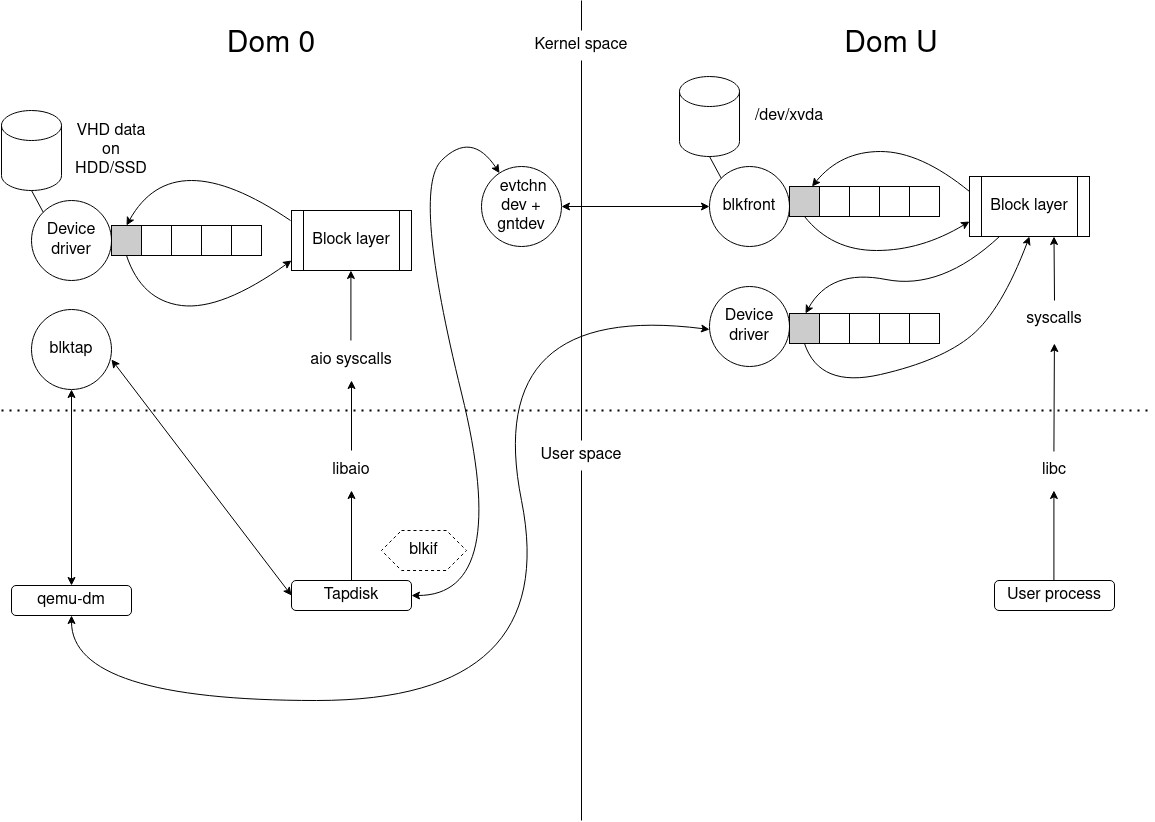
qemu-dm and tapdisk at startup
When a VM starts, whether it is a HVM or a PV guest, it is always started as a HVM. So during the boot process, the device of the VM is emulated. The process for mapping a virtual device from a host to a guest is called qemu-dm. There is one instance per disk like tapdisk, another process used to read/write in a VHD file the disk data. qemu-dm reads and writes to a /dev/blktap/blktapX host device, which is created by tapdisk and is managed by a driver in Dom 0: blktap.
For each read/write in the VM disk, requests pass through an emulated driver, then qemu-dm and finally they are sent to blktap; since tapdisk is the creator/manager of the blktap device, it handles requests by reading them through a shared ring. The requests are consumed by reading or writing in the VHD file representing the disk of the VM, the libaio is used to access/modify the physical blocks. Finally tapdisk responds to qemu-dm by writing responses in the same ring.
tapdisk & PV guests
The process described above is used for HVMs and also for PV guests (at startup, PV drivers are not loaded).
After starting a PV guest, the emulated driver in the VM is replaced by blkfront (a PV driver) which allows to communicate directly with tapdisk using a protocol: blkif; blktap and qemu-dm then become useless to handle devices requests. Note that system calls are used with two drivers: eventchn dev and gntdev to map VM memory pages in the user space of the host. Thus a shared ring can be used to receive requests directly from tapdisk in host user space instead of using the kernel space.
↕️ Components for VDI I/O
XenStore
XenStore is a centralized database residing on Dom0, it is accessible using a UNIX socket or with XenBus + ioctl. It's also a hierarchical namespace allowing reads/writes, enumeration of virtual directories and notifications of observed changes via watches. Each domain has its own path in the store.
A PV driver can interact with the XenStore to get or set configuration, it's not used for large data exchanges. The store is mainly used during PV driver negotiation via XenBus.
For more information, take a look at:
XenBus
XenBus is a kernel API allowing PV drivers to communicate between domains. It's often used for configuration negotiation. It is built over the XenStore.
For implementation, you can take a look at: drivers/xen/xenbus/xenbus_xs.c and drivers/xen/xenbus/xenbus_client.c.
Generally the communication is made between a front and back driver. The front driver is in the DomU, and the back in Dom0. For example it exists a xen-blkfront.c driver in the PV guest and a blkback.c driver in the host to support disk devices. This concept is called split-driver model. It's used for the network layer too.
Note: Like said in the top section, it's not always the case but we can avoid usage of a back driver, we can use a process in the host user space. In the case of XCP-ng, tapdisk/tapback are used instead of blkback to talk with blkfront.
Negociation and connection
Implementation of a Xenbus driver in blkfront:
static const struct xenbus_device_id blkfront_ids[] = {
  { "vbd" }, // Device class.
  { "" }
};

static struct xenbus_driver blkfront_driver = {
  .ids  = blkfront_ids,
  .probe = blkfront_probe, // Called when new device is created: create the virtual device structure.
  .remove = blkfront_remove, // Called when a xbdev is removed.
  .resume = blkfront_resume, // Called to resume after a suspend.
  .otherend_changed = blkback_changed, // Called when the backend's state is modified.
  .is_ready = blkfront_is_ready,
};
In the PV driver, it's necessary to implement these callbacks to react to backend changes. Here we will see the different steps during the negotiation between tapdisk and blkfront. The reactions to changes are made in this piece of code in tapdisk:
int frontend_changed (vbd_t *const device, const XenbusState state) {
  int err = 0;

  DBG(device, "front-end switched to state %s\n", xenbus_strstate(state));
  device->frontend_state = state;

  switch (state) {
    case XenbusStateInitialising:
      if (device->hotplug_status_connected)
        err = xenbus_switch_state(device, XenbusStateInitWait);
      break;
    case XenbusStateInitialised:
    case XenbusStateConnected:
      if (!device->hotplug_status_connected)
        DBG(device, "udev scripts haven't yet run\n");
      else {
        if (device->state != XenbusStateConnected) {
          DBG(device, "connecting to front-end\n");
          err = xenbus_connect(device);
        } else
        DBG(device, "already connected\n");
      }
      break;
    case XenbusStateClosing:
      err = xenbus_switch_state(device, XenbusStateClosing);
      break;
    case XenbusStateClosed:
      err = backend_close(device);
      break;
    case XenbusStateUnknown:
      err = 0;
      break;
    default:
      err = EINVAL;
      WARN(device, "invalid front-end state %d\n", state);
      break;
  }
  return err;
}
And in the PV driver:
static void blkback_changed (struct xenbus_device *dev, enum xenbus_state backend_state) {
  struct blkfront_info *info = dev_get_drvdata(&dev->dev);

  dev_dbg(&dev->dev, "blkfront:blkback_changed to state %d.\n", backend_state);

  switch (backend_state) {
    case XenbusStateInitWait:
      if (dev->state != XenbusStateInitialising)
        break;
      if (talk_to_blkback(dev, info))
        break;
    case XenbusStateInitialising:
    case XenbusStateInitialised:
    case XenbusStateReconfiguring:
    case XenbusStateReconfigured:
    case XenbusStateUnknown:
      break;

    case XenbusStateConnected:
      /*
       * talk_to_blkback sets state to XenbusStateInitialised
       * and blkfront_connect sets it to XenbusStateConnected
       * (if connection went OK).
       *
       * If the backend (or toolstack) decides to poke at backend
       * state (and re-trigger the watch by setting the state repeatedly
       * to XenbusStateConnected (4)) we need to deal with this.
       * This is allowed as this is used to communicate to the guest
       * that the size of disk has changed!
       */
      if ((dev->state != XenbusStateInitialised) && (dev->state != XenbusStateConnected)) {
        if (talk_to_blkback(dev, info))
          break;
      }

      blkfront_connect(info);
      break;

    case XenbusStateClosed:
      if (dev->state == XenbusStateClosed)
        break;
      fallthrough;
    case XenbusStateClosing:
      if (info)
        blkfront_closing(info);
      break;
    }
  }
This negotiation is essentially a state machine updated using xenbus_switch_state in the frontend and backend. They have their own state and are notified when a change is observed. We start from XenbusStateUnknown to XenbusStateConnected.
To detail these steps a little more:
XenbusStateUnknown: Initial state of the device onXenbus, before connection.XenbusStateInitialising: During back end initialization.XenbusStateInitWait: Entered by the backend just before the end of the initialization. The state is useful for the frontend, at this moment it can read driver parameters written by the backend in the Xenstore; it can also write info for the backend always using the store.XenbusStateInitialised: Set to indicate that the backend is now initialized. The frontend can then switch to connected state.XenbusStateConnected: The main state ofXenbus.XenbusStateClosing: Used to interrupt properly the connection.XenbusStateClosed: Final state when frontend and backend are disconnected.
The starting point of the initialization is in xenopsd:
(* The code is simplified in order to keep only the interesting parts. *)
let add_device ~xs device backend_list frontend_list private_list
      xenserver_list =
    Mutex.execute device_serialise_m (fun () ->
        (* ... Get backend end frontend paths... *)
        Xs.transaction xs (fun t ->
            ( try
                ignore (t.Xst.read frontend_ro_path) ;
                raise (Device_frontend_already_connected device)
              with Xs_protocol.Enoent _ -> ()
            ) ;
            t.Xst.rm frontend_rw_path ;
            t.Xst.rm frontend_ro_path ;
            t.Xst.rm backend_path ;

            (* Create paths + permissions. *)
            t.Xst.mkdirperms frontend_rw_path
              (Xenbus_utils.device_frontend device) ;
            t.Xst.mkdirperms frontend_ro_path (Xenbus_utils.rwperm_for_guest 0) ;
            t.Xst.mkdirperms backend_path (Xenbus_utils.device_backend device) ;
            t.Xst.mkdirperms hotplug_path (Xenbus_utils.hotplug device) ;
            t.Xst.writev frontend_rw_path
              (("backend", backend_path) :: frontend_list) ;
            t.Xst.writev frontend_ro_path [("backend", backend_path)] ;
            t.Xst.writev backend_path
              (("frontend", frontend_rw_path) :: backend_list) ;
          (* ... *)
One of the role of xenopsd here is to create VIFs and VBDs to boot correctly a VM. This is the output given when a new device must be added:
/var/log/xensource.log:36728:Nov 24 16:40:24 xcp-ng-lab-1 xenopsd-xc: [debug||14 |Parallel:task=5.atoms=1.(VBD.plug RW vm=6f25b64e-9887-7017-02cc-34e79bfae93d)|xenops] adding device B0[/local/domain/0/backend/vbd3/1/768] F1[/local/domain/1/device/vbd/768] H[/xapi/6f25b64e-9887-7017-02cc-34e79bfae93d/hotplug/1/vbd3/768]
The interesting paths are:
- Backend path:
/local/domain/0/backend/vbd3/1/768 - Frontend path:
/local/domain/1/device/vbd/768
When the two paths are written, the creation of the device connection is triggered. In fact the Xenbus backend instance in the kernel space of Dom0 has a watch on the /local/domain/0/backend/vbd path. Same idea for the /local/domain/<DomU id>/device/vbd in the guest kernel space.
After that the creation/connection can start in tapdisk/tapback. When a new device must be created in the guest, tapback_backend_create_device is executed to start the creation; at this moment parameters like "max-ring-page-order" are written using Xenstore to be read later by the PV driver. Important: only a structure is allocated in memory at this time, there is no communication with the guest, the Xenbus state is XenbusStateUnknown on both sides.
After that the real connection can start, it's the goal of static inline int reconnect(vbd_t *device) in tapback:
-
A watch is added on
<Frontend path>/stateby the backend to be notified when the state is updated. Same idea in the frontend code, a watch is added on<Backend path>/state. -
tapbackis waiting for the hotplug scripts completion of the guest. After that it can switch toXenbusStateInitWaitstate. The frontend can then read the parameters like"max-ring-page-order"and responds using the store.blkfrontcreates a shared ring buffer usingxenbus_grant_ring, so under the hood memory pages are shared between theDomUandDom0to use this ring. Also an event channel is created by the frontend viaxenbus_alloc_evtchnto be notified when data is written in the ring. Finallyblkfrontcan update its state to:XenbusStateInitialised. -
After the last state update,
tapbackcan finalize the bus connection inxenbus_connect: the grant references of the shared ring and event channel port are fetched then it opens ablkifconnection using the details given by the frontend.
References and interesting links:
- Xen documentation: https://wiki.xen.org/wiki/XenBus
- How to write a XenBus driver? https://fnordig.de/2016/12/02/xen-a-backend-frontend-driver-example/
Xen Grant table
The grant table is a mechanism to share memory between domains: it's essentially used in this part to share data between a PV driver of a DomU and the Dom0. Each domain has its own grant table and it can give an access to its memory pages to another domain using Write/Read permissions. Each entry of the table are identified by a grant reference, it's a simple integer which indexes into the grant table.
Normally the grant table is used in the kernel space, but it exists a /dev/xen/gntdev device used to map granted pages in user space. It's useful to implement Xen backends in userspace for qemu and tapdisk: we can write and read in the blkif ring with this helper.
Xen documentation:
Blkif
Shared memory details
Like said in the previous part, when the frontend and backend are connected using XenBus, a blkif connection is created. We know the ring is used in the tapdisk case to read and write requests on a VHD file. It is created directly in blkfront using a __get_free_pages call to allocate a memory pointer, after that, this memory area is shared with Dom0 using this call:
// Note: For more details concerning the ring initialization, you can
// take a look at the `setup_blkring` function.
// ...
xenbus_grant_ring(dev, rinfo->ring.sring, info->nr_ring_pages, gref);
// ...
To understand this call, we can look at this implementation with small comments to understand the logic:
/**
 * xenbus_grant_ring
 * @dev: xenbus device
 * @vaddr: starting virtual address of the ring
 * @nr_pages: number of pages to be granted
 * @grefs: grant reference array to be filled in
 *
 * Grant access to the given @vaddr to the peer of the given device.
 * Then fill in @grefs with grant references.  Return 0 on success, or
 * -errno on error.  On error, the device will switch to
 * XenbusStateClosing, and the error will be saved in the store.
 */
int xenbus_grant_ring (
  struct xenbus_device *dev,
  void *vaddr,
  unsigned int nr_pages,
  grant_ref_t *grefs
) {
  int err;
  int i, j;

  for (i = 0; i < nr_pages; i++) {
    unsigned long gfn;

    // We must retrieve a gfn from the allocated vaddr.
    // A gfn is a Guest Frame Number.
    if (is_vmalloc_addr(vaddr))
      gfn = pfn_to_gfn(vmalloc_to_pfn(vaddr));
    else
      gfn = virt_to_gfn(vaddr);

    // Grant access to this Guest Frame to the other end, here Dom0.
    err = gnttab_grant_foreign_access(dev->otherend_id, gfn, 0);
    if (err < 0) {
      xenbus_dev_fatal(dev, err, "granting access to ring page");
      goto fail;
    }
    grefs[i] = err;

    vaddr = vaddr + XEN_PAGE_SIZE;
  }

  return 0;

fail:
  // In the error case, we must remove access to the guest memory.
  for (j = 0; j < i; j++)
    gnttab_end_foreign_access_ref(grefs[j], 0);
  return err;
}
Event channel & blkif
So, after the creation of the ring, when a request is written inside it by the guest, the backend is notified via an event channel, in this case, an event is similar to a hardware interrupt in the Xen env.
The interesting code is here:
// ...

// Allocate a new event channel on the blkfront device.
xenbus_alloc_evtchn(dev, &rinfo->evtchn);

// ...

// Bind an event channel to a handler called here blkif_interrupt using a blkif
// device with no flags.
bind_evtchn_to_irqhandler(rinfo->evtchn, blkif_interrupt, 0, "blkif", rinfo);
When a request is added in the ring, the backend receives a notification after this call:
void notify_remote_via_irq(int irq)
{
  evtchn_port_t evtchn = evtchn_from_irq(irq);

  if (VALID_EVTCHN(evtchn))
    notify_remote_via_evtchn(evtchn);
}
blkfront can then be notified when a response is written in tapdisk using a function in the libxenctrl API:
int xenevtchn_notify(xenevtchn_handle *xce, evtchn_port_t port);
For more information concerning event channels: https://xenbits.xenproject.org/people/dvrabel/event-channels-F.pdf
Steps during write from guest to host
-
A user process in the guest execute a write call on the virtual device.
-
The request is sent to the
blkfrontdriver. At this moment the driver must associate a grant reference to the guest buffer address using this function (more precisely gfn to which the address belongs):
static struct grant *get_grant (
  grant_ref_t *gref_head,
  unsigned long gfn,
  struct blkfront_ring_info *rinfo
) {
  struct grant *gnt_list_entry = get_free_grant(rinfo);
  struct blkfront_info *info = rinfo->dev_info;

  if (gnt_list_entry->gref != GRANT_INVALID_REF)
    return gnt_list_entry;

  /* Assign a gref to this page */
  gnt_list_entry->gref = gnttab_claim_grant_reference(gref_head);
  BUG_ON(gnt_list_entry->gref == -ENOSPC);
  if (info->feature_persistent)
    grant_foreign_access(gnt_list_entry, info);
  else {
    /* Grant access to the GFN passed by the caller */
    gnttab_grant_foreign_access_ref(
      gnt_list_entry->gref,
      info->xbdev->otherend_id,
      gfn,
      0
    );
  }

  return gnt_list_entry;
}
If you want more info concerning the persistent feature: https://xenproject.org/2012/11/23/improving-block-protocol-scalability-with-persistent-grants/
The persistent grants are not used in tapdisk.
-
The grant reference is then added to the ring, and the backend is notified.
-
In tapdisk when the event channel is notified, the request is read and the guest segments are copied into a local buffer using
ioctlwith aIOCTL_GNTDEV_GRANT_COPYrequest. So before writing to the VHD file we must make a copy of the data. Another possible solution is to use theIOCTL_GNTDEV_MAP_GRANT_REF+ ammapcall to avoid a copy, but it is not necessarily faster. -
Finally we can write the request and notify the frontend.
The read steps are similar, the main difference is that we must copy from the Dom0 VHD file to the guest buffer.
📡 API
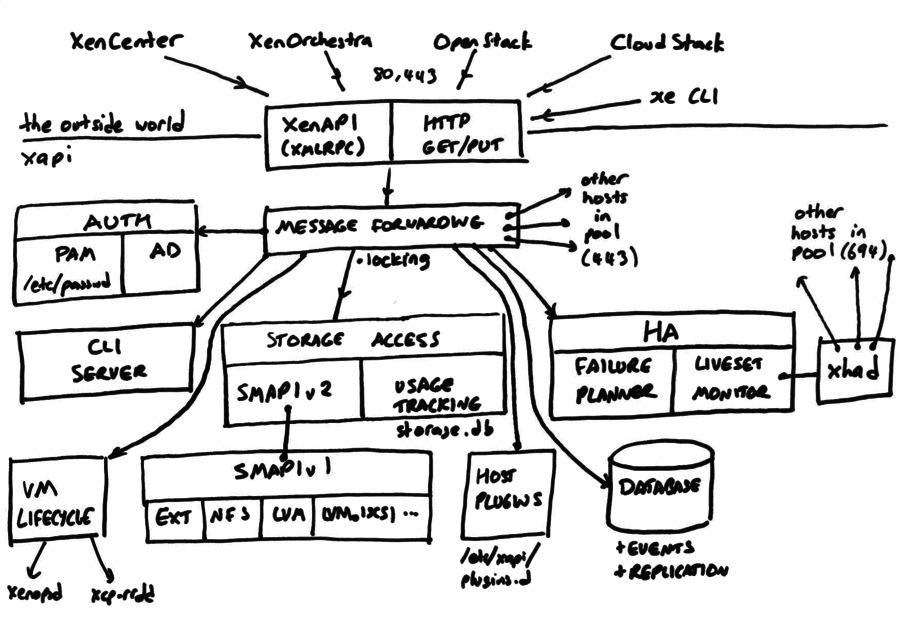
XCP-ng uses XAPI as main API. This API is used by all clients. For more details go to XAPI website.
If you want to build an application on top of XCP-ng, we strongly suggest the Xen Orchestra API instead of XAPI. Xen Orchestra provides an abstraction layer that's easier to use, and also acts as a central point for your whole infrastructure.
XAPI architecture
XAPI is a toolstack split in two parts: xenopsd and XAPI itself (see the diagram below):
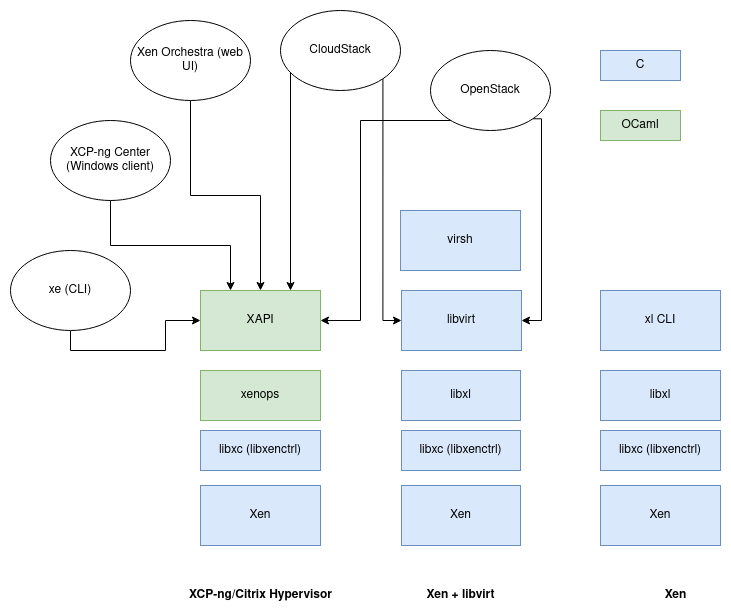
XCP-ng is meant to use XAPI. Don't use it with xl or anything else!
General design
Objects
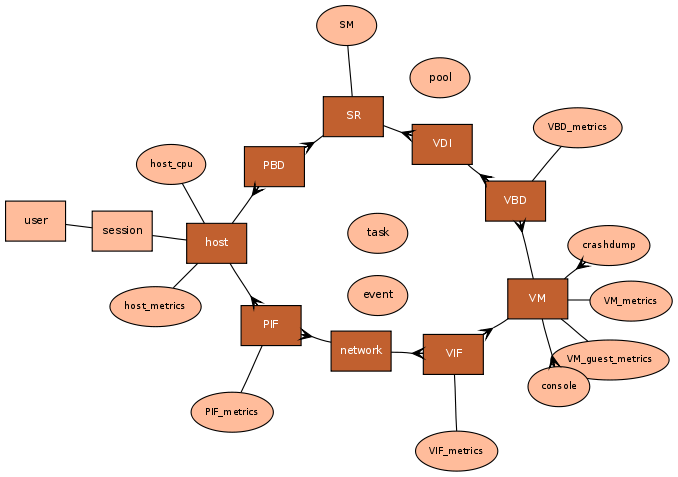
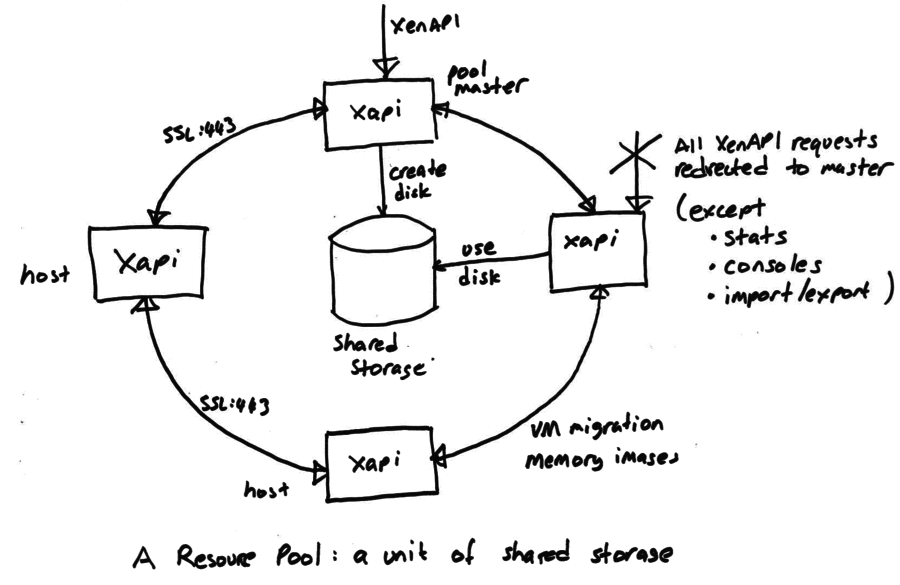
Pool design
🕸️ Network
Overview
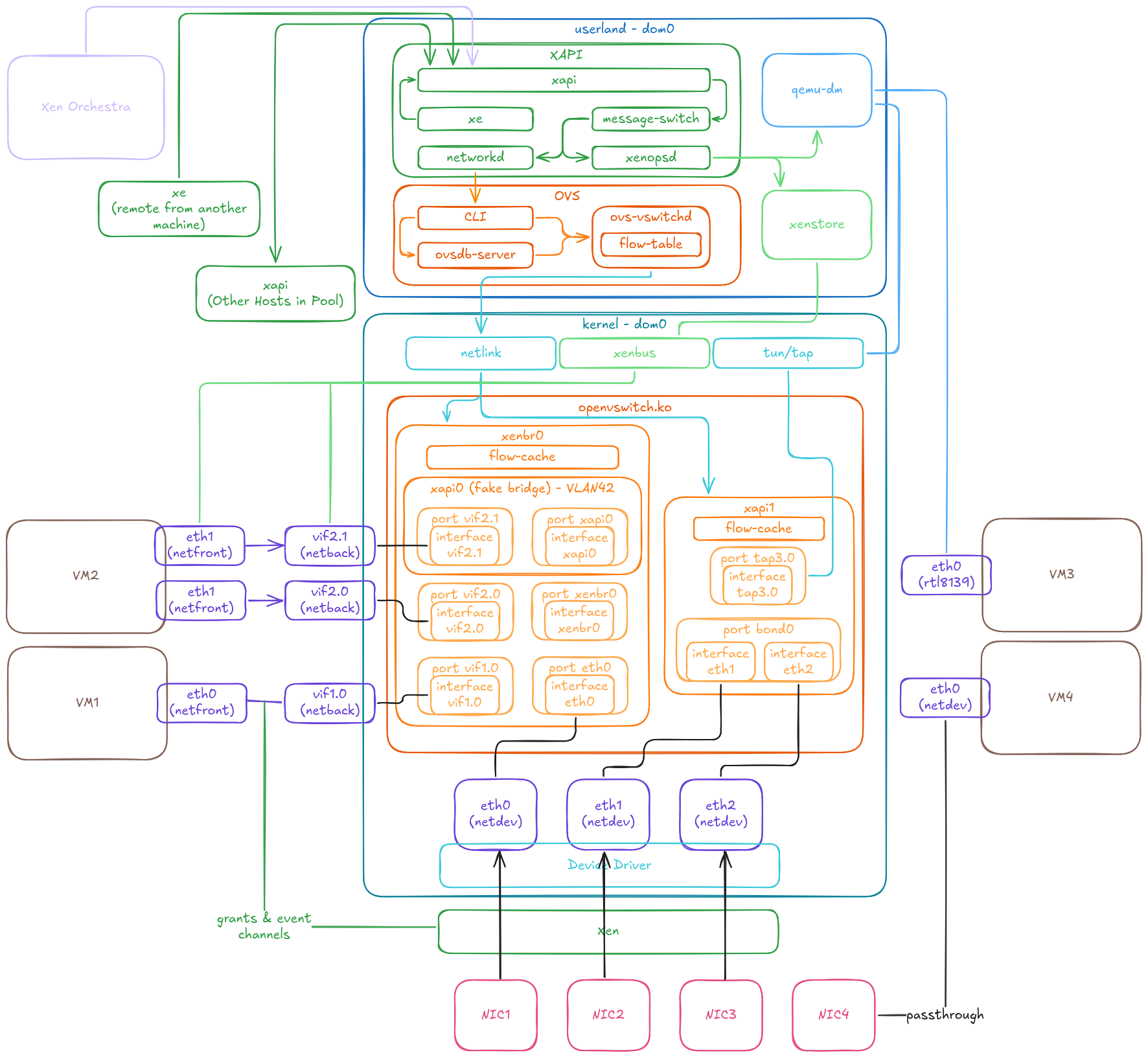
At the highest level, Xen Orchestra and xe commands interact with XAPI to manage network configuration. The xapi daemon provides the main API, receiving requests and passing them to message-switch, which dispatches commands to the appropriate daemon. For networking, this is xcp-networkd, which applies the required configuration using Open vSwitch (OVS) commands.
In XCP-ng, all networking is managed by OVS:
- The
openvswitch.kokernel module handles bridges, bonds, and actual network traffic. ovsdb-serverstores and applies OVS configuration.ovs-vswitchdis the main OVS daemon, managing each bridge’s backend and flow table.
The bonds and bridges are all OVS ones. XCP-ng does not use linux bridges or bonds. For example, a bond0 device won't appear in ip link as it only exists as a port of an OVS bridge. To have an ip used for it, it will have to be set on the matching bridge interface.
Almost all configuration is handled through XAPI, ensuring pool-wide consistency. Only Xen Orchestra’s SDN Controller plugin interacts directly with ovsdb-server, ovs-vswitchd for Global private network and traffic rules respectively. These exceptions are detailed in later sections.
XAPI Objects
The core concepts are introduced on the Networking page. Here, we explain their operation and underlying mechanisms. XAPI stores the configuration and relationships for these objects, then configures OVS on each host in the pool.
Configuration is stored on the master’s XAPI, which then propagates it to pool members.
Networks
A Network in XCP-ng is a layer 2 segment that VMs can join, providing flexible infrastructure options. Networks are created at the pool level and backed by an OVS Bridge on each host in the pool (or across pools for Global Private Networks). Each Network is then available to VMs running on that pool.
Network types include:
- Default Networks: A NIC provides external connectivity.
- Bonded Networks: Multiple NICs are bonded for redundancy or increased throughput.
- VLAN Networks: VLANs layered on Default or Bonded networks (can be implicitly created).
- Private Networks: Internal-only, with no external connectivity.
- Global Private Networks: Layer 3 tunnels (GRE or VXLAN) connect multiple hosts, even across pools as long as they have IP connectivity.
At the XAPI level, Networks are associated with PIFs for external access and VIFs for VM traffic.
PIFs
PIF stands for Physical Interface, but it can represent more than just a physical NIC. A PIF is any network interface that provides external connectivity for a host:
- Physical Interfaces: Standard NICs (e.g.,
eth0), mapped directly to hardware. - Bonds: Aggregations of multiple physical interfaces for redundancy or throughput.
- Tunnels: Used for Global Private Networks (GRE or VXLAN), creating overlays across hosts.
- VLANs: Layered on other PIF types, supporting 802.1Q VLAN tagging.
VIFs
VIFs are virtual network interfaces attached to VMs. Each VIF has an interface inside the VM (e.g., eth0, enp1s0) and another on the host (vifX.Y, tapX.Y where X = domain ID, Y = VIF number). At a high level (as shown in Xen Orchestra), each VIF connects to a Network. Internally, the VM uses its interface as a normal NIC, while the host-side interface is bound to the bridge for that Network. The following sections describe the two VIF models.
Emulated NICs
When booting an HVM VM, an emulated NIC (typically Intel E1000 or Realtek RTL8139) is used. These are fully emulated by qemu-dm, with a tap device created on the host. The tap device is bound to the appropriate bridge. Emulated NICs are widely supported by guest OS drivers but offer lower performance than para-virtualized NICs.
Para-virtualized NICs
Para-virtualized NICs use Xen’s PV drivers (xen-netfront in the guest and xen-netback in the host). They are mostly interesting for offering improved performance over emulated devices.
If the VM has the necessary drivers, it replaces the emulated device once loaded. On the host, a vifX.Y interface is created and bound to the bridge. The VM and host negotiate the connection via XenBus and XenStore, using Xen’s grant tables and event channels for packet exchange.
Although Xen Orchestra’s Advanced tab shows Intel e1000 or Realtek RTL8139, once para-virtualized drivers are loaded, the emulated device is no longer used.
OVS
Key Elements
Here’s a glossary of main OVS elements (details follow):
- Bridges: Configurable virtual switches.
- Datapath: Packet processing component of a bridge.
- Flow Table: List of OpenFlow rules for packet handling.
- Flow Cache: Matched flows within the datapath.
- Ports: Logical bridge ports, each with one or more interfaces.
- Interfaces: Actual devices in dom0 (e.g.,
eth0,vif1.0,tap2.0,xenbr0,xapi1).
Bridges
Networking in XCP-ng centers on “networks”, each backed by an OVS bridge on relevant hosts.
Two key points:
- If no VM on a host uses a network, its bridge is not created, and the PIF appears “Disconnected” in Xen Orchestra.
- The PIF is not forcibly disconnected if no more VMs use it. This is expected and does not cause any issue.
A bridge consists of:
- Configuration in
ovsdb-server. - Flow table in
ovs-vswitchd. - Datapath in
openvswitch.ko. - Ports matching XAPI’s PIFs and VIFs.
- One or more interfaces per port.
- An “internal port” with a matching interface of type “internal.”
The ovs-vsctl show command displays all bridges, ports, and interfaces currently configured in OVS. For example:
    Bridge xenbr0
        fail_mode: standalone
        Port vif1.0
            Interface vif1.0
        Port eth0
            Interface eth0
        Port xenbr0
            Interface xenbr0
                type: internal
VLANs
The way we handle VLAN in OVS is somewhat unique. When you create a network in XOA, you select a PIF to back it. On the OVS side, if a bridge without VLAN tagging does not already exist (e.g., xenbrX for standard networks), it will be created. Then, an additional "fake bridge" is created (typically named xapiX, where X is a number). The ports of this fake bridge are assigned a VLAN tag and are added to the xenbrX bridge. This setup allows OVS to:
- Create OpenFlow rules that tag or untag VLAN IDs as packets leave the bridge.
- Control which ports can communicate with each other, even though they appear on the same
xenbrXbridge.
VMs are unaware of the VLAN they are on; traffic remains untagged as long as it stays within the bridge. For example, two VMs on the same host and VLAN network can communicate without VLAN tags ever being applied. However, they cannot reach VMs connected to xenbrX without a tag. When a VM sends traffic outside the host, the VLAN tag is added before the packet leaves through the appropriate NIC. Conversely, incoming tagged frames are untagged when entering the bridge. This means OpenFlow rules cannot match on VLAN tags for internal traffic, as the tag is only present when the frame exits the bridge.
Although the fake bridge exists as a bridge, not all bridge-related commands work on it. For example, after adding a VLAN network on eth0, ovs-vsctl list-br shows:
xapi0
xenbr0
Here, xapi0 is a bridge, but as a fake bridge, it lacks its own datapath or flow table:
# ovs-ofctl dump-flows xapi0
ovs-ofctl: xapi0 is not a bridge or a socket
Additionally, ovs-vsctl show does not display it as a separate bridge, but instead shows all its ports under xenbr0 with their respective VLAN tags:
    Bridge xenbr0
        fail_mode: standalone
        Port xapi0
            tag: 2121
            Interface xapi0
                type: internal
        Port vif1.0
            Interface vif1.0
        Port eth0
            Interface eth0
        Port xenbr0
            Interface xenbr0
                type: internal
        Port xapi9
            tag: 2142
            Interface xapi9
                type: internal
        Port vif20.1
            tag: 2121
            Interface vif20.1
Although its ports are added to xenbr0 it does have a list of its own ports:
# ovs-vsctl list-ports xapi9
vif20.1
This makes it easier to identify its ports and interfaces than trying to match the tags to a port.
Bonds
Bonds aggregate multiple interfaces into a single port within a bridge. OVS manages this entirely. To list bonds:
# ovs-appctl bond/show
---- bond0 ----
bond_mode: balance-tcp
bond may use recirculation: no, Recirc-ID : -1
bond-hash-basis: 0
updelay: 31000 ms
downdelay: 200 ms
lacp_status: configured
active slave mac: 12:60:84:5c:1f:74(eth0)

slave eth0: enabled
        active slave
        may_enable: true

slave eth1: enabled
        may_enable: true
For LACP bonds, use the ovs-appctl lacp/show command for more details.
To see the overall organization, use ovs-vsctl show:
    Bridge xapi1
        fail_mode: standalone
        Port bond0
            Interface eth0
            Interface eth1
        Port xapi1
            Interface xapi1
                type: internal
Global Private Networks (tunnels)
Global private networks are managed by Xen Orchestra's SDN Controller plugin, also documented in the XCP-ng SDN Controller documentation. Here, we explain their setup within OVS.
A network is created, and its associated bridge is created on the required hosts. Unlike other network types, these can span multiple pools, which is why the SDN Controller plugin is needed as XAPI is not aware of other pools. After the bridge is created, tunnels (GRE or VXLAN, encrypted or not) are established between the center host and all hosts in the included pools. For encrypted tunnels, libreswan is used for IPsec, establishing routes at the kernel level. This currently limits you to one encrypted tunnel per protocol, as multiple tunnels would attempt to set the same route.
In cross-pool setups, networks created on each pool have the same name, but their XAPI UUIDs will differ, as UUIDs are unique per pool.
These networks create their own bridges, and you can identify them by a port name <bridge>_portX, which will have a type indicating the protocol and a remote_ip field. This is visible in the ovs-vsctl show output:
    Bridge xapi7
        Controller "pssl:"
        fail_mode: standalone
        Port xapi7_port5
            Interface xapi7_iface5
                type: gre
                options: {key="11", remote_ip="192.168.1.220"}
        Port xapi7
            Interface xapi7
                type: internal
        Port vif28.3
            Interface vif28.3
On the central host, there will be one interface with a remote_ip per host, and each remote host will have a single interface pointing to the center's IP, as shown above.
Configuration flow
Network creation
Network creation is triggered via XO or xe, passing through XAPI, which instructs OVS to create the corresponding bridge. The following diagrams illustrate the process at a high level and then zoom in on the XAPI and OVS components.
High level flow:
XAPI flow:
OVS flow:
Global Private Networks creation
To simplify the diagram, names have been shortened:
- XO SDN refers to XO and its SDN Controller plugin.
- XAPI center is the master XAPI on the central host.
- XAPIs are the master XAPI instances on other pools.
- OVS refers to OVS on each host.
OpenFlow rules
There are currently two ways to manage traffic rules:
- The legacy method, where the SDN Controller plugin communicates directly with
ovs-vswitchdto add or remove flows. - The new (BETA) method, which uses a XAPI plugin to manage OpenFlow rules locally by running OVS commands.
The legacy approach is simpler but limited: ovs-vswitchd only listens for a single datapath, making it difficult to configure multiple networks or fake bridges (used for VLANs). The new approach, using a XAPI plugin, overcomes these limitations by allowing each host to define rules locally, with full access to all datapaths, ports, and interfaces.
OpenFlow protocol
XAPI plugin
Packet flow
This section traces the path of packets arriving from outside to reach a VM. The same principles apply to VM-to-VM traffic.
NL stands for netlink. OVS uses Netlink almost exclusively, to communicate between the kernel and userland, through Generic Netlink commands.