Introduction
XCP-ng is a high performance enterprise level virtualization platform with a rich ecosystem, that can be integrated in an entire stack to do management and backup for it (see Xen Orchestra section for that). XCP-ng stands for Xen Cloud Platform - next generation: it is the modern successor to XCP, initially created as an Open Source version of Citrix XenServer back in 2010.
XCP-ng is, by default, a secure platform to run any kind of virtualization workload, while being managed by a central administration console, integrated with an API and CLI but also compatible with Packer, Terraform and Ansible.
Visit the main website to learn more. Latest updates are published on our blog, don't miss any announcement there!
Discover the growing network around XCP-ng and Xen Orchestra, collectively known as the Vates Stack. Visit the ecosystem page at the Vates VMS documentation to explore our current partnerships and certification opportunities. Interested in joining? We’d love to hear from you!
Where to start
Which documentation for what?
Three documentation sets work together. Knowing which one to open saves time:
As a rule of thumb: if it happens on a host or pool, it's documented here; if you do it from Xen Orchestra, it's in the XO docs; if it's about the offer around the software (trial, licenses, support, certified hardware), it's on the Vates docs.
General design
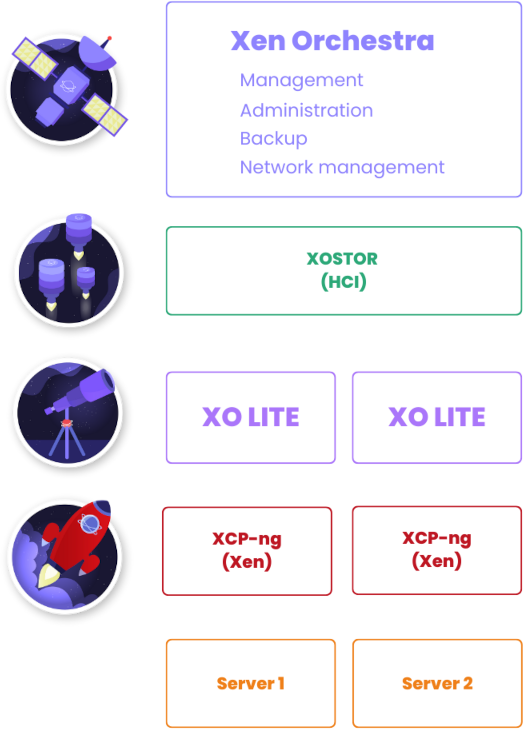
XCP-ng contains multiple components, built around the Xen Hypervisor. It's meant to run on top of bare-metal machines.
Stack overview
The main goal of XCP-ng is to be a fully integrated and dedicated virtualization platform, without requiring any deep Linux or system knowledge. It's meant to be managed in a centralized manner via Xen Orchestra, whether you have only one host or thousands of them. Backup is also included inside Xen Orchestra.
Concepts
There are a few concepts to grasp in order to get a clear picture about what XCP-ng is.
Turnkey appliance
XCP-ng is distributed as an ISO file you can download here and install on the hardware of your choice (see our hardware support section for more details). It's meant to be an appliance, already pre-configured to run any kind of virtual machine you need without any preparation.
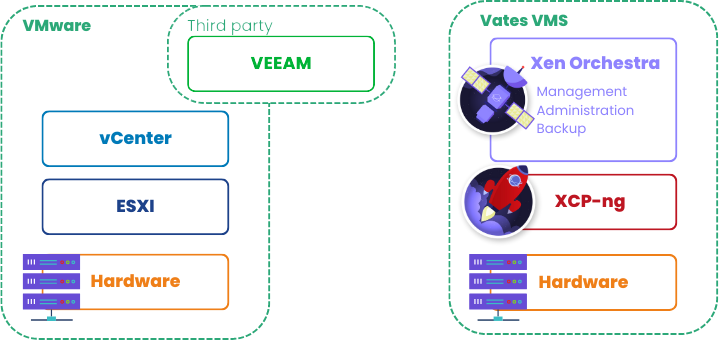
Compared to VMware
In terms of general architecture, XCP-ng and Xen Orchestra are relatively close. See for yourself:
Managing XCP-ng
Now you have your hosts running, the next step is to manage them. You have various options to do so, choose the one that fits best! See the dedicated management section.
Host API architecture
All XCP-ng clients are communicating with the pool master, through the Xen API (XAPI). You only need to open a connection to the master, even if there are multiple hosts.
Some clients are stateless (only running when you open or use them) and others are stateful (running in a daemon, often in a dedicated VM). For very basic management tasks, stateless clients are fine. However, for more advanced features, you need stateful clients. The default choice is to use Xen Orchestra, but a list of solutions is available in our management section.
Backup
Xen Orchestra is a complete and agentless backup solution for your VMs running on XCP-ng. Please read the dedicated backup section to get more details.
Community videos on XCP-ng
Those videos are made by 3rd parties. However, for example, Tom from Lawrence Systems is providing a lot of content on XCP-ng and Xen Orchestra. Check his YouTube channel.
Tom's video explaining what XCP-ng is:
A quick intro by Raid Owl:
Project and community
XCP-ng is a community-driven Open Source project, backed by Vates. Everything about the project itself (roadmap, contributing, development process, security handling) lives in the project pages.
- Latest news: xcp-ng.org/blog
- Community forum: xcp-ng.org/forum
- YouTube channel: @Vates_tech